- Let's Talk About Tech
- Posts
- The godfather of AI is alarmed
The godfather of AI is alarmed
Discover why a creator of AI resigned, what Google is doing to stay in the race and how employees feel about the technology seeping into their workplaces.

Holly Slattery & Jackson Miller
May 21, 2023
Hello and welcome back!
In this instalment of Let’s Talk About Tech, we recap what’s new with AI before doing a bit of a deep dive. Basically, you can expect:
The rundown of this fortnight’s top three stories
An explainer of large language models
A practical review of Motion
Some food for thought on disinformation in an AI-driven world
Extra resources (for the eager beavers out there)
We want to keep things short and strong to help spark important conversations around our stimulating world of tech, so let’s get into it!
THE RUNDOWN

Wait… whose godfather is alarmed about AI?
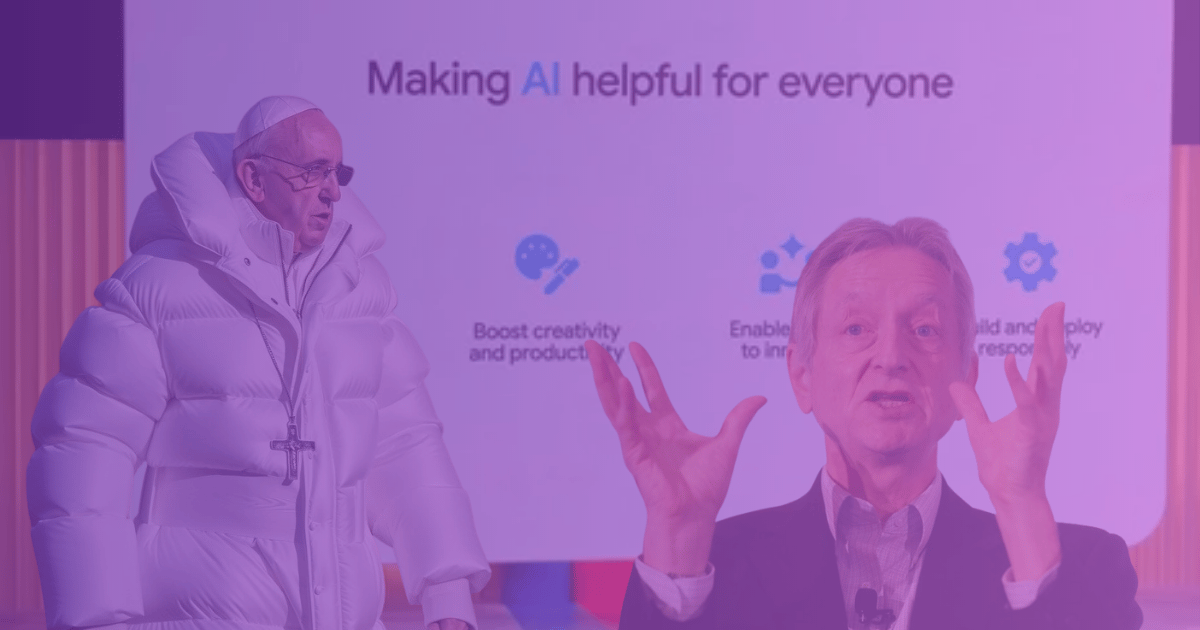
Affectionately known as the ‘Godfather of AI’, Geoffrey Hinton stepped down from his research role at Google so he could speak freely about his concerns with the technology he helped create.
Dr. Hinton, who’s acclaimed for pioneering the neural network, expressed concerns about AI upending the job market and learning toxic behaviours from the loads of data it analyses.
But he seemed more alarmed by AI’s ability to create images, text and video that isn’t real.
Want to know what’s (potentially) so bad about getting creative with AI? We’ve got some food for thought in store, so keep reading.
Google launches “next generation language model” to stay in the race
Last week Google introduced PaLM2, a new language model with improved multilingual, reasoning and coding capabilities. This means that not only can the model be used to power ChatGPT-style chatbots, it can also translate between languages, write computer code and analyse and respond to images (more on this here).
With the AI arm’s race well and truly ramping up, PaLM2 is already incorporated into 25 Google products and powers the company’s own chatbot, Bard.
It’s essentially Google’s way of competing with players like Microsoft, a company that was quick off the mark to adopt AI by integrating GPT-4 (the large language model developed by OpenAI) into its own search engine, Bing.
Psst. In case you’re wondering what the heck a large language model actually is, scroll on. We’ve got you.
Study shows more employees want to turn to AI, not against it
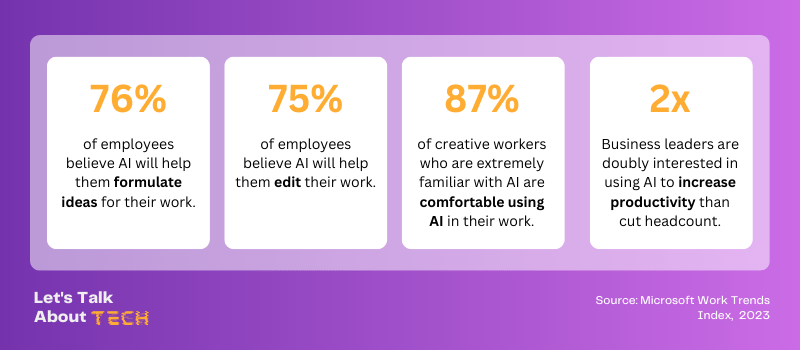
Microsoft has tried to capture how people in the workplace feel about AI in its latest Work Trends Index.
Turns out that although almost half (49%) of the surveyed employees are worried AI will replace their job, even more (70%) are willing to delegate as much work as possible to AI as a means to reduce their workloads.
The stats go to show that AI optimism in the workplace is a thing, particularly when it comes to eliminating the ‘digital debt’ in our everyday working lives. Something you can learn more about here.
ASKING FOR A FRIEND…
What exactly is a large language model?
Between telling you about the launch of Google’s PaLM2 and sharing insights into the use of GPT-4, we thought it was about time to nail what a large language (LLM) model actually is.
Think about a LLM as one big library containing information on everything in the world… countless shelves of books on everything you can imagine, from the quadratic formula to the intimate relationship between the Ancient Greeks and grapes.
We need a librarian to help us navigate the depth of information in this library. And just like your local library, there’s a selection of possible librarians: the young, modern, beanie-wearing hipster or the old, wise, glasses-wearing expert, for example.
This choice of librarian represents the act of selecting your artificial intelligence chatbot (like GPT-4 from OpenAI or Bard from Google), which - upon receiving your prompt - helps you find an answer by navigating all the sources of information in the library.
When you can comprehend the depth of information in the library (ie. the LLM) and the role of the librarian (ie. the chatbot) in navigating that information, you can see why it’s so important to write precisely and articulately when providing prompts, like questions and requests.
Essentially, the more precise the prompt, the more accurate the result in terms of context and the purpose of the output. (This is the craft of AI prompt writing!)
You can’t currently self-navigate through these libraries outside of commercial use. But a collaborative project called RedPajama has been launched by a range of AI-focused research institutions and other companies in an attempt to democratise access to LLMs.
A PRACTICAL REVIEW
Motion
Brought to you by Jackson, who trialled and tested this tool for a week and is here to give you his honest opinion.
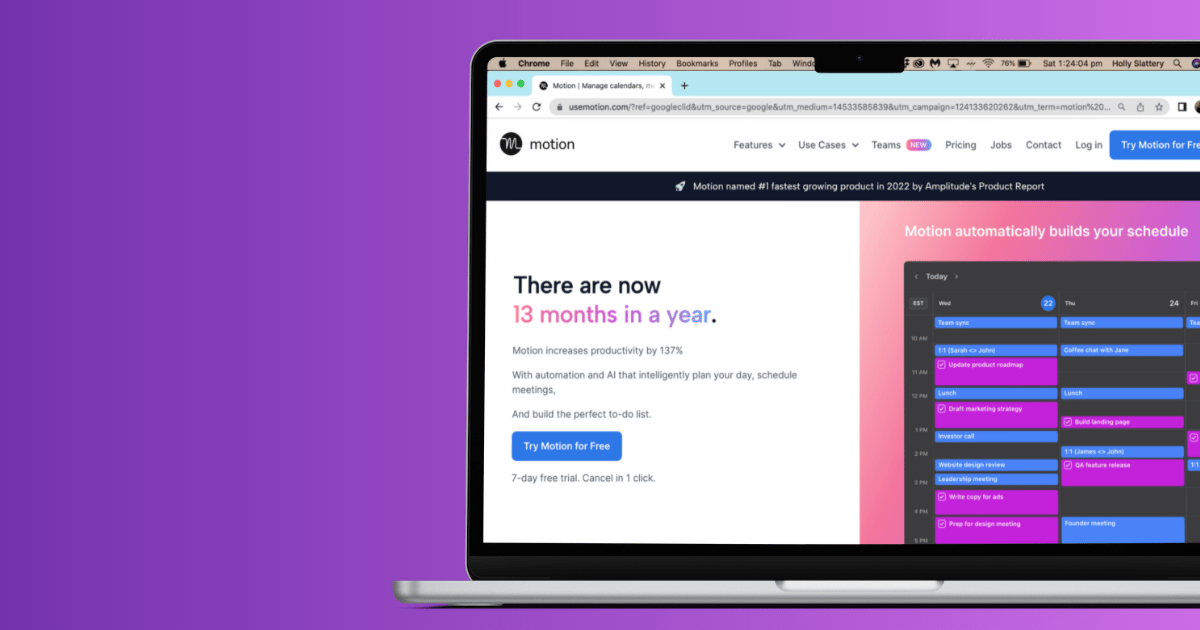
I’ve been considering working with a virtual assistant for a while. And after a relentless series of targeted Instagram ads further called out my apparent incapacity to self-manage my time, I succumbed… and downloaded Motion.
Motion auto-schedules project tasks in your calendar around your events and based on your working hours. It considers the tasks’ respective deadlines, the projects timeline, and its urgency to ensure you get done all you desire.
Despite following the onboarding videos instructions – and attempting to digest the platform’s important distinctions between tasks, projects, bookings and the calendar – it wasn’t intuitive. And the user experience was kinda clunky, especially when you have multiple calendars which you want to overlay.
However, the biggest challenge was one of self-motivation because Motion eliminates your ability to self-select time and task allocation. Having your autonomy stripped like this and replaced by machine-generated instruction on how to spend the next hour is a unique feeling, and one I honestly struggled with.
With that said, the ability to make compulsory auto-scheduled 10-15min blocks either side of meetings, intended for prep or follow-ups, generated a good practice of accountability. And the rescheduling of incomplete tasks to the next available time slot throughout the week was valuable for the same reason.
Overall, I recommend everyone to give the week free-trial a whole-hearted and committed shot – if not for the time-saving factor which comes from reduced to-do list writing, then for the self-reflections which will likely follow around autonomy and time allocation.
Motion showed me how frequently I typically task-switch – a practice that’s shown to inhibit daily satisfaction due to the number of tasks that are left incomplete. And while being accountable to an AI-generated schedule didn’t work for me in the weeklong period I trialled Motion – I recognise the productive value it could cultivate if fully adhered to, so I’m diving deeper.
If you trial Motion, let us know how you go!
SOME FOOD FOR THOUGHT
What’s so bad about getting creative with AI?
Earlier, we talked about Dr. Hinton being worried about AI’s ability to create never-before-seen images and video. But what’s so bad about that?
Well, audio-visual content generated by AI opens the floodgates to a whole new era of misinformation and disinformation that can be super convincing, divisive and threatening to our democracy.
From seemingly harmless ‘photos’ of the Pope flexing a Balenciaga-style puffer jacket and videos of Lebron James travelling six steps without dribbling, to more sinister creations like deepfakes and propaganda that can have serious social and political consequences, we now have the means to create it all.
Without disclaimers or context, photos and videos created using AI apps like Midjourney, DALL-E 2 and Synthesia can easily be mistaken for legitimate scenarios and events. And the spread of this AI-generated disinformation online is making it more difficult than ever to keep a shared reality intact.
In the words of Subbaro Kambhampati, a computer science professor at Arizona State University:
“You lull people into not double checking. Then you are shifted little by little from reality.”
Now, that’s not to say these tools and new capabilities won’t serve us any good.
Midjourney’s new version 5.1 is one of many offerings out there that provide a whole host of new possibilities for art and image creation which - when used thoughtfully - can be really productive, innovative and inspiring.
So the question remains: just how do we toe the line between ethics and innovation?
(Hint: it’s a tricky one and we, being Jackson and Holly, certainly don’t have all the answers! But we do recommend listening to the Your Undivided Attention podcast episode that’s in the list below.)
Looking for something other than your #FYP to keep you informed?
(That’s ‘for you page’, for the boomers out there.)
Well, if you thought the stuff we covered in this newsletter was interesting and you’re in the mood to dive a little deeper, here are some things we’ve run our ears and eyes over and curated just for you:

Thanks for talking about tech with us - we hope this helped wrap your head around what’s new in the land of AI, from the buzz around language models to the risks of getting artsy with AI.
Stay tuned for the latest news, reviews and more in next fortnight’s newsletter. And why not tell your friends about us? We’re sure they’d love to be in the loop.